

I. Product Overview
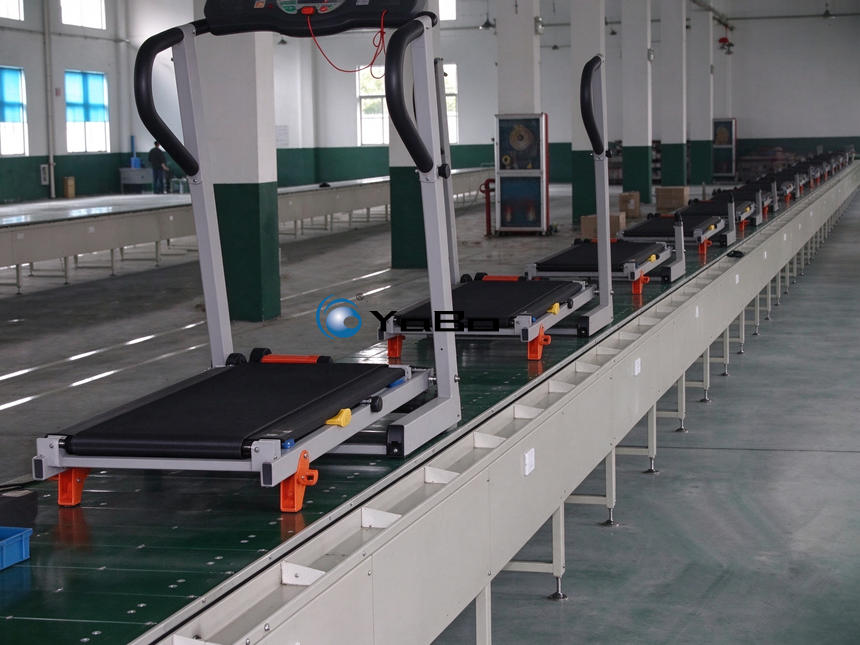
The slat chain treadmill production line is a complete production and conveying system specially designed for the full assembly of household treadmills. It is suitable for large-scale final assembly of all specifications of household folding treadmills and small commercial treadmills. A treadmill integrates the running deck frame, drive motor, rollers, running belt, electrical control console, handrail and upright post, with strict requirements on running stability, electrical control reliability and assembly precision. In traditional fixed-station assembly, full-machine transfer relies on manual handling, resulting in high risk of collision damage; key processes such as power-on commissioning and load testing are scattered, making unified quality data traceability difficult, and model changeover is inefficient when running multiple models in mixed production.
This slat chain treadmill line adopts a heavy-duty slat chain conveying structure, where the tooling load surface directly carries the complete treadmill and conveys it in continuous step motion according to the production takt. It can complete online power-on commissioning and running tests, fully covering the entire process from frame pre-assembly, running deck assembly, drive system installation, electrical fitting, power-on commissioning, performance testing, to final inspection and off-line.
The complete line consists of a heavy-duty slat chain conveyor main body, drive and tensioning mechanism, station blocking and positioning devices, electrical VFD control system, and quality traceability module. The slat chain load surface is flat with strong load capacity, suitable for conveying complete treadmills; operation is smooth without jolting, reducing collision and scratch damage to the frame, running belt and sheet metal parts. Positioning stops are provided on the load surface to secure the machine during assembly, making it easy for workers to perform precision operations such as motor installation, belt tensioning and console wiring.
Stations are equipped with material racks, power-on test tooling and performance test modules, plus station-level industrial control terminals and barcode scanners that bind the full-machine SN number, collecting running parameters, torque data and electrical parameters. The system can interface with MES for full-process quality traceability of each individual treadmill. Tooling positioning parts can be quickly changed over to accommodate mixed production of treadmills of different sizes and functions, making the line suitable for new assembly workshops or upgrades of old assembly lines at fitness equipment manufacturers. The line solves problems such as difficult full-machine transfer, scattered commissioning processes and quality data gaps, detecting abnormal running noise, electrical faults and belt misalignment at an early stage and stabilizing the production takt. The slat chain supports station accumulation buffering, so rework at a single station does not affect the operation of the whole line.
II. Assembly Process Flow
During line operation, the treadmill frame is placed on the slat chain tooling load surface and circulates in step motion. The core processes are as follows:
- Frame loading station: The main frame is hoisted onto the slat chain positioning station, the SN code is scanned and recorded, and the frame flows to the next process.
- Running deck pre-assembly station: Assemble the front and rear rollers, running belt and base board to complete the basic deck structure, and initially adjust belt tension.
- Drive system assembly station: Install the drive motor, transmission mechanism and incline motor; fix the motor bracket; connect the transmission parts.
- Electrical and console assembly station: Install the main control board, operating console, wiring harness and safety switch; complete wiring and fixing.
- Handrail and upright post assembly station: Install the handrails, upright posts, operation panel and safety lock to complete the full-machine structure assembly.
- Power-on commissioning station (core process): Power on the full machine to test speed adjustment, incline adjustment and emergency stop functions; calibrate belt misalignment; check running noise and stability.
- Final inspection station: Re-check running performance, electrical safety, overall appearance and accessory completeness, and judge pass/fail.
- Off-line station: Qualified products are folded and packed for warehousing; unqualified products are reworked on site and re-enter the test stations; empty tooling returns to the loading station with the slat chain.
Key features of the slat chain conveying solution: heavy-duty load capacity for complete treadmills; online commissioning reduces secondary transfer and improves test efficiency; the slat chain is oil-resistant and impact-resistant, well suited to fitness equipment workshop environments.
III. Customizable Technical Parameters
| Category | Technical Parameter | Description & Optional Configurations |
|---|---|---|
| Conveying Main Body | Conveying type | Heavy-duty slat chain conveyor; supports step/continuous dual-mode switching |
| Slat chain material | Standard: galvanized carbon steel; optional: 304 stainless steel; anti-slip, oil-resistant, impact-resistant surface | |
| Frame material | Carbon steel square tube, integrally welded, powder coated; high heavy-load strength | |
| Drive mode | VFD gear motor drive with overload and over-current protection; stable operation | |
| Conveying speed | 0.5–5 m/min, VFD adjustable; precisely settable by production takt | |
| Line layout | Straight / U-shaped / closed-loop return layouts optional; supports double-layer layout with single-layer assembly and lower-layer tooling return | |
| Line specification | Single standard section ≤ 30 m; total length spliced as required; number of stations customized by capacity | |
| Tooling Load & Positioning | Load mode | Direct slat chain surface load / tooling pallet load (two options) |
| Positioning mechanism | Adjustable mechanical positioning stops, adaptable to different treadmill sizes; buffered anti-collision at ends | |
| Load surface protection | Optional anti-slip cushion pads to avoid frame sheet metal scratches and paint chipping | |
| Rated load per station | 50–300 kg customized; covers household to small commercial treadmills of all series | |
| Electrical & MES System | Control mode | PLC + HMI centralized control; local operation / remote management mode switch |
| Data collection | Station barcode scanners bind the SN code; automatically collect tightening torque, running parameters and electrical data | |
| Standard functions | Process anti-error, audible/visual alarms, production statistics, defective product classification records | |
| System integration | Supports integration with the factory MES for full-process quality traceability | |
| Integrated Test Modules | Electrical testing | Optional hipot (withstand voltage) test, ground resistance test and power test units |
| Performance testing | Optional online test tooling for belt misalignment calibration, running noise and load performance | |
| Safety testing | Optional emergency stop function and safety lock response test units | |
| Compatibility & Expansion | Compatible products | Household folding treadmills, small commercial treadmills, walking pads and other fitness equipment |
| Expansion interfaces | Reserved interfaces for robot loading, automatic marking, automatic packing and palletizing stations |