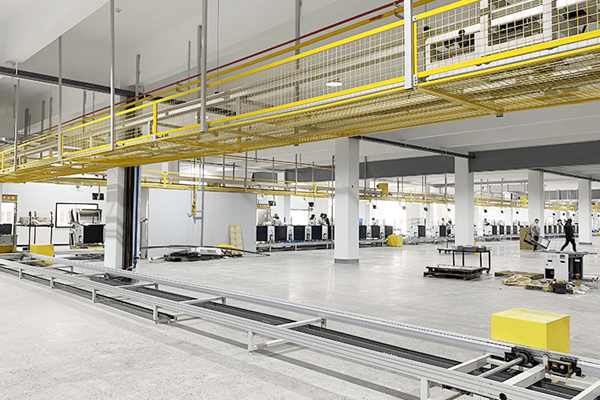
Integrated Stove Assembly Line
Engineering Excellence in Kitchen Appliance Manufacturing
Production Ecosystem Overview
The integrated stove assembly line shown here represents a comprehensive production ecosystem for combination cooking units. These sophisticated appliances merge gas burners, electric ovens, exhaust hoods, and control systems into unified platforms. The facility demonstrates how advanced conveyor architecture, spatial planning, and process engineering converge to deliver high-quality cooking equipment at industrial scale.
Material Logistics Infrastructure
Overhead Distribution Network. The elevated conveyor network suspended from the ceiling serves as the primary material distribution backbone. This yellow-railed overhead track system transports sub-assemblies, components, and finished modules between storage areas and production stations. Unlike ground-level systems that compete for floor space, this overhead configuration frees the production floor for value-adding activities while maintaining continuous material flow.
Structural Support System. The overhead track is constructed from structural steel trusses with integrated wire mesh safety decking, providing load-bearing capacity and fall protection. Yellow powder-coated railings serve dual functions: visual identification of elevated work zones and physical containment of transported materials. The vertical support columns anchor both the conveyor and building framework, engineered to withstand dynamic loading, vibration, and static weight of accumulated inventory.
Primary Production Conveyor
Chain-Driven Pallet System. The main production conveyor runs at floor level, comprising a chain-driven pallet system with aluminum frame construction. Dark conveyor segments in the foreground represent heavy-duty chain mechanisms capable of transporting integrated stove chassis, oven cavities, and completed units. The chain drive configuration is selected for its durability under high-torque conditions and precise indexing accuracy for automated operations.
Modular Segmentation. The conveyor divides into modular sections with integrated lift-transfer units, enabling lateral pallet movement between parallel process lines or buffer zones. This supports mixed-model production where the same physical line can sequentially assemble different stove configurations without dedicated changeover downtime.
Buffer Accumulation Points. Yellow buffer stations positioned at intervals provide controlled accumulation where work-in-process can be staged without disrupting main line flow. These buffers absorb variability in station cycle times, preventing minor delays from propagating into systemic throughput losses.
Workstation Organization
The assembly line follows a linear process flow with stations arranged by operational dependency.
Initial stations address chassis preparation and structural welding or fastening of the oven cavity frame. These operations require heavy tooling and precision alignment capabilities.
Mid-line stations focus on gas distribution systems including burner assemblies, flame control valves, and safety shutoff mechanisms. These operations demand specialized tooling and certified technician oversight due to the regulatory compliance requirements of gas appliance manufacturing.
Electrical system integration follows, encompassing control panels, ignition systems, temperature sensors, and smart connectivity modules. These stations require electrostatic discharge protection and clean working conditions.
Final stations handle cosmetic assembly including door panel installation, handle attachment, and surface finish inspection, followed by comprehensive functional testing. The clean, organized appearance of distant workstations suggests rigorous 5S workplace organization practices where tools, components, and documentation are systematically positioned to minimize operator motion waste and reduce error rates.
Facility Architecture
Industrial Design Features. The production hall exhibits high ceilings with integrated LED lighting arrays, polished concrete flooring resistant to thermal cycling and chemical exposure, and expansive column spacing. Bright, uniform illumination eliminates shadowing that could obscure defect detection or compromise precision during detailed assembly tasks.
Flexible Partitioning. The building’s structural bay design enables flexible partitioning into clean zones, sub-assembly areas, and testing chambers with varying environmental controls. This adaptability is essential for integrated stove manufacturing, where electronic control boards require electrostatic discharge protection while painted surfaces demand controlled humidity.
Operational Philosophy
Balanced Investment. The line embodies a progressive philosophy balancing capital investment in automation with skilled labor adaptability. Substantial infrastructure investment in overhead conveyors, heavy-duty floor systems, and purpose-built architecture reflects confidence in sustained market demand. Simultaneously, open workstation design preserves human oversight for complex assembly judgments and quality verification tasks.
Inherent Scalability. Additional conveyor segments can be inserted to extend production capacity. Parallel stations can be established for high-volume operations. The overhead material network can be re-routed to support new product introductions without disrupting existing workflows.
Conclusion
This integrated stove assembly line addresses the unique challenges of complex appliance production through vertical material logistics integration, robust floor-level conveyor architecture, and strategically organized process flow. The facility achieves the production velocity necessary for market competitiveness while maintaining the precision and safety standards that cooking appliances demand. As consumer preferences evolve toward multi-functional kitchen solutions, this manufacturing infrastructure provides the adaptive, scalable foundation required to translate engineering innovation into reliable, mass-produced reality.