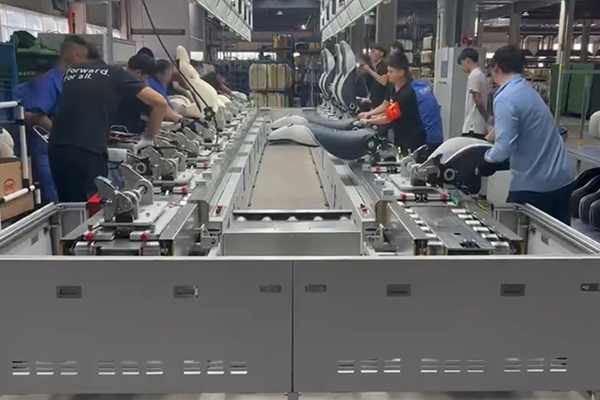
Automotive Seat Assembly Line
System Overview
The automotive seat assembly line depicted in this image represents one of the most technically demanding segments of vehicle interior production, where ergonomic design, safety compliance, and mass manufacturing efficiency must coexist within a single integrated process. This facility demonstrates how modern conveyor engineering, workstation ergonomics, and systematic quality protocols converge to produce seating systems that directly influence occupant comfort, crash protection, and the overall perceived quality of the finished vehicle.
Dual-Track Pallet Conveyor Architecture
The central production conveyor employs a dual-track pallet-based system specifically engineered for the sequential assembly of automotive seat frames and cushion modules. Two parallel conveyor lanes run in opposite directions, creating a continuous circuit that delivers empty pallets to loading stations and returns completed seat assemblies to removal points. This closed-loop configuration maximizes pallet utilization efficiency while minimizing the floor space required for pallet storage and staging.
The visible pallets are precision-machined fixtures that securely cradle seat frame components during assembly operations. Each pallet incorporates locating pins, clamping mechanisms, and orientation guides that ensure repeatable positioning of metal frame structures, foam cushions, and trim covers. This fixture-based approach is essential for automotive seating, where dimensional tolerances measured in millimeters directly impact installation compatibility with vehicle floor pans and adjustment mechanism alignment.
The conveyor drive mechanism beneath the gray protective enclosures utilizes a chain or belt-driven indexing system capable of precise station-to-station advancement. Indexing accuracy is critical in this application because many assembly operations require exact positional alignment between the seat structure and automated or semi-automated tooling.
Workstation Configuration and Ergonomic Design
Assembly stations are arranged in bilateral symmetry along the conveyor, with operators positioned on both sides of the production line to minimize reach distances and maximize spatial efficiency. This dual-sided layout is characteristic of high-volume automotive component manufacturing, where labor utilization directly influences unit production costs.
The workstation design reflects deliberate ergonomic engineering. Seat cushion modules and trim components are presented at heights and angles that minimize operator bending, reaching, and twisting motions. The partially assembled seat structures visible on the line demonstrate progressive build states: bare metal frames at upstream stations, foam-padded cushions at mid-line positions, and nearly completed assemblies with trim covers and headrests at downstream operations.
Operator positioning relative to the conveyor is optimized for the specific tasks performed at each station. Frame welding or fastening operations require close proximity to the pallet fixture, while upholstery attachment and quality inspection benefit from slightly elevated vantage points that enable visual verification of seam alignment, cover tension, and cosmetic surface integrity.
Progressive Assembly Sequence and Component Integration
The production sequence follows a logical dependency chain that begins with structural frame assembly and culminates in fully functional seat modules ready for vehicle installation.
Initial stations address the construction of the seat pan and backrest frame, typically involving stamped steel or aluminum components joined through resistance welding, riveting, or threaded fastening. These structural elements must satisfy stringent crashworthiness requirements, maintaining integrity under the dynamic loads experienced during frontal, side, and rear-impact events.
Mid-line stations integrate comfort and convenience systems including multi-density foam cushions engineered for pressure distribution, heating and ventilation elements for climate control, and powered adjustment mechanisms such as track slides, recliners, and height-adjustment motors. Each of these subsystems requires dedicated electrical connections, pneumatic tubing, or mechanical linkages that must be installed with absolute reliability given the difficulty of service access once seats are installed in vehicles.
Downstream stations address trim cover installation, a labor-intensive process involving material stretching, seam alignment, and attachment clip engagement that still resists full automation due to the variability of textile and leather materials. The black and gray seat assemblies visible in various completion states illustrate this progression, with some units displaying exposed foam and others presenting finished leather or synthetic surfaces.
Safety-critical components including side-impact airbag modules and seatbelt anchor points receive dedicated attention at specialized stations where certified technicians perform installation and verification. These operations are subject to enhanced documentation requirements, torque specification compliance, and 100% inspection protocols that exceed the sampling-based quality approaches applied to cosmetic features.
Quality Assurance and Traceability Infrastructure
Automotive seating manufacturing operates under stringent quality management systems, typically certified to IATF 16949 standards. The assembly line incorporates multiple verification checkpoints where dimensional measurements, functional tests, and visual inspections are performed before units advance to subsequent operations.
Component traceability is maintained throughout the process, with each seat assembly linked to a unique identifier that records the manufacturing date, workstation assignments, operator identifications, and component batch numbers. This traceability infrastructure enables rapid containment and root-cause analysis in the event of field quality concerns, a capability that automotive original equipment manufacturers increasingly mandate from their supply base.
Material Flow and Production Logistics
The background environment reveals the material logistics infrastructure supporting the assembly line. Component racks, staging containers, and overhead material delivery systems ensure that operators have continuous access to required parts without production interruption. The green and yellow storage elements visible in the periphery represent kanban-based inventory management, where component replenishment is triggered by consumption rather than forecast-driven batch delivery.
This just-in-time material flow strategy minimizes work-in-process inventory, reduces floor space requirements, and limits the capital tied up in unconverted components. However, it demands exceptional supply chain reliability, as any material shortage at a single station can halt the entire production line.
Conclusion
This automotive seat assembly line exemplifies how modern manufacturing engineering addresses the complex requirements of safety-critical, comfort-oriented vehicle components. Through dual-track conveyor architecture, ergonomic workstation design, and systematic progressive assembly, the facility achieves the production velocity necessary for automotive volume demands while maintaining the precision and traceability standards that regulatory compliance and brand reputation require. As vehicle electrification and autonomous driving reshape interior design priorities, such manufacturing infrastructure provides the adaptive foundation necessary to produce next-generation seating systems that balance traditional comfort expectations with emerging functional requirements.