

I. Overview
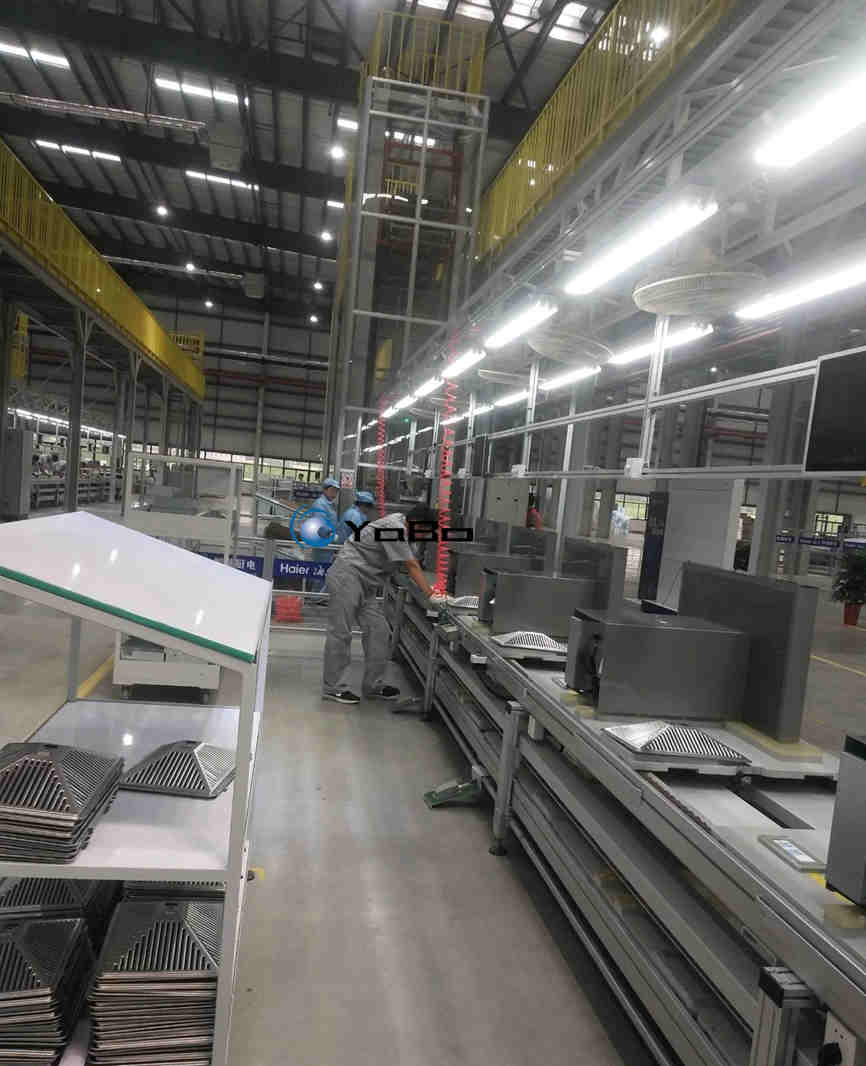
The range hood is an essential kitchen appliance and a high-volume, fast-replacing category. Kitchen appliance manufacturers generally require stable, efficient, multi-model compatible assembly methods for complete-machine production. The range hood production line is a conveying assembly system designed specifically for range hood assembly, testing and off-line, suitable for co-production of wall-mounted, island and integrated range hood models. The line adopts an aluminum-frame powered roller conveyor structure with modular station layout, equipped with material racks, pneumatic tools, an electrical control system and station displays, covering the full process from sheet metal parts, filters, motors and housings to complete-machine assembly, performance testing, aging test and packing.
The powered roller conveyor carries pallets continuously at a set takt time, keeping operations smoothly linked between stations, standardizing assembly procedures, reducing defect rates and manual handling, and suitable for large-volume continuous production in kitchen appliance factories. The line structure is proven and easy to maintain, and can be flexibly arranged according to workshop space and capacity requirements. It is a mature conveying solution widely adopted in kitchen appliance and small appliance assembly workshops, and the same structure can also be applied to integrated cooker hoods, dishwashers, rice cookers and other similar kitchen appliance complete-machine assembly.
II. Assembly Process
The range hood assembly line is divided into stations by process segment, with pallets moving along the powered roller conveyor in an orderly sequence:
- Parts loading station: operators place stainless steel housings, inlet filters, motors, control boards and power cords on the pallet, and the pallet moves along the conveyor.
- Pre-assembly station: motor fixing, fan wheel assembly and internal wire harness connection are completed; a suspended pneumatic wrench (air tool) is provided at the station, with pneumatic hoses routed overhead to keep bolt torque under control.
- Housing assembly station: the housing is joined and seals are installed; a multi-level material rack beside the station holds stacked filters and inlet grilles nearby, where filter pre-positioning is completed to reduce walking for parts pickup.
- Electrical test station: power-on testing checks button functions, fan start/stop, lighting and negative-pressure performance, identifying circuit faults.
- Aging test station: the complete machine runs under power for continuous aging, simulating long-duration operation to screen out early failures in advance.
- Appearance re-inspection station: housing scratches, assembly gaps and part completeness are checked.
- Off-line packing station: qualified units are scanned, packed in cartons and removed from the line.
The line is equipped with aluminum material racks for storing filters and sheet metal parts nearby, reducing operator walking for parts pickup and improving takt time. Station displays show work instructions, station output and defect data for on-site production information management. Stations are designed at ergonomic working height with suspended pneumatic tools, reducing operator fatigue. With fixed work sequences and clear operation steps, the line reduces dependence on individual operator skill and ensures consistent quality across shifts and batches.
III. Customizable Parameters
- Conveying type: powered roller conveyor (can be replaced with slat conveyor or trolley type)
- Compatible models: wall-mounted, island and integrated range hoods, supporting co-production of multiple models
- Line length: customized to workshop space, 30–200 m as required
- Pallets: aluminum frame with anti-static plate, custom positioning fixtures for quick changeover
- Conveying speed: 0.5–6 m/min, variable-frequency adjustable; takt time can be adjusted to capacity requirements
- Station configuration: torque control system, power-on test module, aging test section and lift-and-transfer mechanism are optional
- Frame material: industrial aluminum profile or carbon steel with powder coating, two options available
- Extension modules: lift-and-transfer units, return level and vertical stacker can be added for pallet loop return
- Control method: PLC + touchscreen centralized control; data can be integrated with the customer’s existing management system
- Extended industries: the same conveying structure applies to complete-machine assembly of integrated cooker hoods, dishwashers, rice cookers, air fryers and other kitchen and small appliances, with pallets and positioning fixtures customized for each model