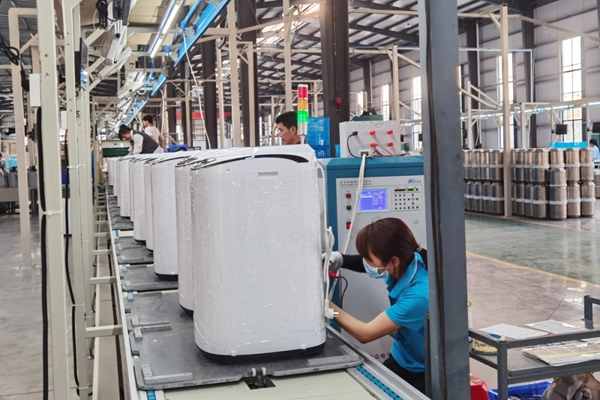
Our company specializes in the design, engineering, and integration of high-capacity automated assembly lines for major home appliance production. The image above showcases one of our flagship installations, a precision-engineered washing machine production line that demonstrates the core capabilities of our pallet-based conveyor systems and process-oriented manufacturing methodology.
Pallet Conveyor System Architecture
The assembly line in the photograph features a pallet-based conveyor system, a configuration widely adopted in the appliance industry for its ability to handle heavy, bulky products while maintaining precise positioning at each workstation. The conveyor consists of a continuous chain or roller track system that transports individual pallets, each carrying a single washing machine unit, through sequential assembly stations.
The pallets are engineered from high-strength steel or aluminum, designed to support loads typically ranging from 30 to 100 kilograms depending on product specifications. Each pallet is fitted with precision locating fixtures that secure the appliance housing in a fixed orientation, ensuring consistent positioning for automated and manual assembly operations. The conveyor drive mechanism employs a motor-controlled chain or belt system with variable speed capability, allowing production managers to adjust line speed from 0.5 to 2 meters per minute to match the required assembly tempo and operator capacity.
Station-Based Assembly Process Flow
The line is organized into discrete, sequential workstations, each dedicated to a specific manufacturing operation within the overall assembly sequence. The process begins at the first station where the washing machine drum and tub assembly are mounted onto the pallet fixture. As the pallet advances along the conveyor, it passes through stations where operators perform critical assembly steps including motor installation, suspension system mounting, control panel wiring, water inlet valve connection, and drainage system assembly.
The pallet-based configuration ensures that each unit remains at a consistent height and orientation throughout the process, eliminating the need for operators to reposition or lift heavy components. This ergonomic design reduces operator fatigue and improves assembly accuracy while maintaining a steady production rhythm.
Inline Testing and Quality Verification Stations
A defining feature of our assembly line design is the integration of dedicated testing stations positioned at strategic points along the conveyor. The image shows a testing station where an operator is performing functional verification using a specialized test rig connected to the appliance. These inline testing stations typically include automated electrical safety testing, water leakage detection, spin cycle performance verification, and control system calibration.
The test equipment is interfaced with a programmable logic controller or manufacturing execution system that records test data for each unit, enabling full traceability and immediate identification of quality deviations. Units that fail testing are automatically diverted to a repair station via a bypass conveyor or manual removal system, preventing defective products from advancing to final packaging.
Overhead Material Delivery and Component Feeding
The line architecture incorporates an overhead component delivery system, visible in the image as a suspended track or conveyor running parallel to the main assembly line. This overhead system delivers sub-assemblies, components, and packaging materials directly to workstations, reducing floor-level congestion and improving material flow efficiency.
Components such as control boards, wiring harnesses, and hardware kits are staged in designated bins or totes at each station, following a just-in-time replenishment schedule. This integrated material handling approach minimizes operator walking time and ensures that assembly stations are continuously supplied without interrupting the production flow.
Structural Framework and Ergonomic Design
The assembly line is supported by a robust structural framework constructed from structural steel or aluminum extrusion, providing the rigidity required to support heavy appliance loads and resist deflection during operation. The framework includes integrated operator platforms, safety guardrails, and overhead lighting fixtures positioned to provide uniform illumination at each workstation.
Workstation heights are optimized for standing or seated operation, with adjustable fixtures that accommodate different operator statures and product configurations. The open-frame design allows for easy access to mechanical and electrical components for maintenance, while the modular construction permits sections to be replaced or reconfigured without dismantling the entire line.
Control System Integration and Production Monitoring
The conveyor system is controlled by a centralized PLC or distributed control system that manages pallet indexing, station sequencing, and inter-station communication. Each workstation is equipped with sensors and actuators that signal completion of assembly tasks and authorize pallet advancement to the next station.
The control system enforces a paced production rhythm, preventing station overload and ensuring balanced workflow across the line. Real-time production monitoring displays, typically mounted above the line, provide operators and supervisors with visibility into current output rates, station cycle times, and quality metrics. This data-driven approach enables rapid identification of bottlenecks and supports continuous process improvement initiatives.
Scalability and Product Changeover Capability
Our pallet-based assembly lines are engineered for production flexibility, allowing manufacturers to accommodate multiple product models on a single line. Quick-change pallet fixtures and adjustable tooling enable rapid product changeovers, typically completed within 30 to 60 minutes.
The modular line segments can be extended, shortened, or reconfigured to match changing production volumes or factory layouts. Additional stations for new assembly processes, such as smart connectivity module installation or energy efficiency testing, can be integrated without disrupting existing operations. This scalability ensures that the assembly line remains a productive asset throughout the product lifecycle and across multiple product generations.
Safety and Compliance Features
The line design incorporates comprehensive safety features including emergency stop stations at regular intervals, light curtains or physical guards at automated stations, and lockout-tagout provisions for maintenance access. The conveyor system includes anti-jam sensors and overload protection to prevent mechanical damage and ensure operator safety.
All electrical and control systems are designed to comply with relevant industrial safety standards, including CE, UL, or equivalent regional certifications depending on the installation location.
Conclusion
The washing machine assembly line depicted in this image represents a complete manufacturing solution engineered to optimize production efficiency, ensure consistent product quality, and provide the operational flexibility required in the competitive appliance industry. By combining robust pallet-based conveyor technology with intelligent process control, inline quality verification, and integrated material handling, our assembly line systems enable manufacturers to achieve higher throughput, reduced labor costs, and superior product reliability. Whether for washing machines, dryers, refrigerators, or other major appliances, our production lines deliver the engineering precision and process discipline that modern appliance manufacturing demands.