Introduction
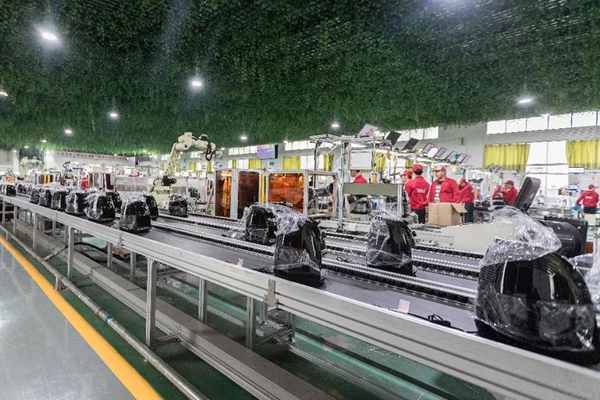
Our company specializes in the design, engineering, and deployment of high-performance automated assembly lines for consumer appliance manufacturing. The image above showcases one of our flagship installations, a precision-engineered air fryer production line that exemplifies the core capabilities of our conveyor-based assembly systems.
Line Architecture and Structural Design
The assembly line in the photograph features a modular conveyor system built on a robust aluminum or cold-rolled steel frame structure, designed for durability and long-term stability in high-volume production environments. The conveyor belt itself is a continuous-loop system driven by an AC motor with variable speed control, allowing operators to adjust line speed to match the required production tempo, typically ranging from 7.5 to 10 minutes per unit depending on product complexity and automation level.
The belt surface is constructed from PVC or similar industrial-grade material, selected for its wear resistance, anti-static properties, and ease of maintenance. The entire line is supported by a structural framework that includes integrated side tables, safety guardrails, and ergonomic workstation positioning to optimize operator workflow and reduce fatigue during extended production runs.
Workstation Configuration and Process Flow
The line is organized into sequential assembly stations, each dedicated to a specific manufacturing operation. The process begins with component feeding and sub-assembly preparation, where individual parts such as housings, heating elements, control panels, and internal wiring are staged and delivered to the line via automated material handling or manual loading at designated infeed points.
As units move along the conveyor, they pass through stations where operators or automated equipment perform critical assembly steps including component insertion, screw fastening, electrical connection, and functional testing. The modular design of the line allows for flexible workstation configuration, meaning stations can be added, removed, or reconfigured to accommodate different product models or production volume changes without requiring a complete line rebuild.
Integration of Automation and Manual Operations
This particular installation demonstrates a semi-automatic operational model, where human operators work alongside automated equipment to achieve optimal efficiency. Robotic arms or automated assembly machines are positioned at stations requiring high precision or repetitive motion, while human operators handle more complex tasks requiring judgment and dexterity.
The line supports programmable logic controller integration, enabling centralized control of conveyor speed, station sequencing, and equipment coordination. This hybrid approach leverages the consistency and speed of automation for standardized tasks while preserving the adaptability of skilled labor for quality-sensitive operations and product changeovers.
Quality Control and Inline Testing
A critical feature of our assembly line design is the integration of inline testing and quality inspection stations. As units progress through the line, they undergo automated functional testing at predetermined checkpoints, typically including power-on verification, temperature control calibration, safety interlock testing, and electrical performance measurement.
These testing stations are equipped with data acquisition systems that capture real-time performance metrics, enabling immediate identification of defects and preventing non-conforming units from advancing to packaging. This inline quality control methodology significantly reduces rework rates and ensures that finished products meet stringent performance and safety standards before leaving the production floor.
Conveyor System Engineering and Material Handling
The conveyor system itself represents the backbone of the production line, engineered for smooth, continuous product transport with minimal vibration or jarring that could damage sensitive components. The belt width and payload capacity are calculated based on product dimensions and weight, with typical configurations accommodating loads up to 100 kg per unit.
The drive mechanism includes a motorized pulley system with adjustable tensioning to maintain consistent belt tracking and prevent slippage. Emergency stop buttons and safety interlocks are integrated at regular intervals along the line, ensuring operator safety and compliance with industrial workplace regulations. The system can be configured for straight-run, curved, or multi-level layouts depending on factory floor space constraints and production flow requirements.
Scalability and Production Flexibility
One of the defining advantages of our assembly line solutions is their inherent scalability. The modular construction allows manufacturers to extend line length, add parallel processing stations, or integrate additional automation equipment as production demands grow. Quick-change tooling and adjustable fixtures enable rapid product changeovers, allowing the same line to produce multiple product variants with minimal downtime.
This flexibility is particularly valuable in the appliance industry, where manufacturers must respond quickly to seasonal demand fluctuations, new product launches, and design modifications.
Ergonomic and Environmental Considerations
The line design incorporates ergonomic principles to enhance operator comfort and productivity. Workstation heights are adjustable, and component presentation systems minimize reaching and bending. The overhead lighting and environmental controls visible in the installation ensure adequate illumination and climate management for precision assembly work.
Additionally, the line layout facilitates efficient material flow, with designated areas for component staging, work-in-progress inventory, and finished goods accumulation, reducing congestion and improving overall floor space utilization.
Technical Specifications and Customization
Our assembly lines are fully customizable to meet specific manufacturing requirements. Standard configurations include voltage options of 220V, 380V, or 415V, semi-automatic or fully automatic operation modes, and belt lengths ranging from 100 to 2,000 meters depending on plant layout.
| Specification | Options Available |
|---|---|
| Voltage | 220V / 380V / 415V |
| Operation Mode | Semi-automatic / Fully automatic |
| Belt Length | 100 – 2,000 meters |
| Frame Material | Cold-rolled steel / Aluminum / Stainless steel |
| Surface Treatment | Epoxy powder coating for corrosion resistance |
The structural framework is available in cold-rolled steel, aluminum, or stainless steel, with surface treatments including epoxy powder coating for corrosion resistance. We provide comprehensive engineering support including factory layout design, equipment installation, commissioning, and operator training, ensuring seamless integration into existing manufacturing operations.
Conclusion
The assembly line depicted in this image represents more than just a conveyor system. It is a complete manufacturing solution engineered to optimize production efficiency, ensure consistent product quality, and provide the operational flexibility required in today’s competitive appliance market.
By combining robust mechanical design with intelligent automation integration and rigorous quality control, our assembly line solutions enable manufacturers to achieve higher throughput, reduced labor costs, and superior product reliability. Whether for air fryers, small appliances, or other consumer electronics, our production lines deliver the performance and adaptability that modern manufacturing demands.