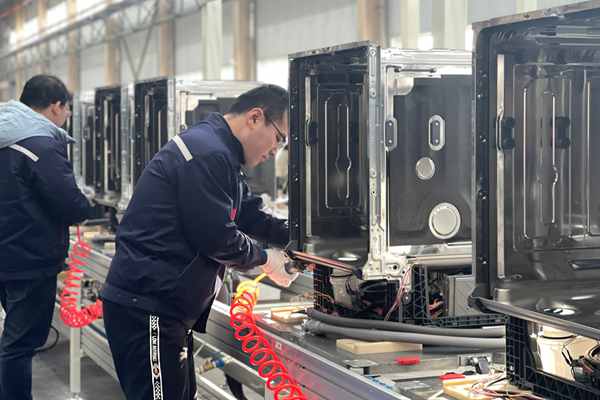
Dishwasher Assembly Line: Precision Engineering from Component to Finished Product
Manufacturing System Overview
At our manufacturing facility, we specialize in designing and building high-performance assembly lines that transform raw dishwasher components into market-ready appliances. The image captured on our production floor illustrates a critical phase in the dishwasher tub assembly process, where precision engineering meets skilled craftsmanship on a purpose-built conveyor system.
Assembly Line Architecture
Our dishwasher assembly line is engineered as a modular, multi-station production system that handles the complete lifecycle of the dishwasher inner tub, from sheet metal forming to final component integration. The line operates on a continuous-flow conveyor principle, where each workstation is positioned at precise intervals to maintain a synchronized takt time across the entire production sequence.
The conveyor backbone of our line uses a double-speed chain system that provides both rapid transit between stations and accurate positioning at each work cell. This dual-speed capability is essential for large appliance manufacturing, where bulky components such as the stainless steel inner tub require smooth, controlled movement without compromising throughput. The chain conveyor is complemented by roller sections at inspection and loading stations, allowing operators to rotate and manipulate the tub for ergonomic access to all assembly points.
Tub Assembly Process: Stage by Stage
Forming and Pre-Assembly
The production journey begins with the side-back-side flat panel, which undergoes U-bending on a servo-driven forming station. This electric cylinder-powered mechanism ensures consistent bend angles and radius control across every unit, eliminating the dimensional variation that plagues manual bending operations. The formed panel is then transferred via robotic gripper to the pre-assembly station, where it is joined with the upper and bottom covers.
Clinching Operation
A critical process step visible in our production image is the clinching operation. We employ TOX clinching technology, a mechanical joining method that creates cold-formed, interlocking joints without welding, fasteners, or adhesives. This process is driven by servo electric cylinders with precision tooling, using 4mm to 6mm clinching tools depending on the joint specification. It ensures uniform joint strength and eliminates the thermal distortion associated with conventional welding. The clinching matrix is continuously lubricated via an auto-lubrication system integrated into the guide rails and sliders, maintaining tool life and joint quality over extended production runs.
Roll Seaming Station
Following structural joining, the assembly moves to the roll seaming station, where the bottom and upper sections are mechanically seamed to the side wrapper using a 10-roll servo-driven system. This station achieves a cycle time of under 15 seconds per unit, with a track mold controlling roll action to maintain seam alignment within 1mm tolerance. The casted machine frame provides long-term stability, preventing deformation that could compromise seam quality over thousands of production cycles.
Sealing and Reinforcement Integration
The sealing support, critical for the dishwasher’s watertight integrity, is formed from coil stock through a dedicated sub-line comprising decoiler, forming, cutting, bending, and notch-cutting stations. This inline forming approach eliminates intermediate handling and ensures the sealing frame matches the tub geometry precisely. The formed seal is then clinch-attached to the tub, followed by hinge plate installation and frame reinforcement clinching at corner joints.
Our assembly line is designed for model flexibility, accommodating multiple dishwasher variants such as 710mm and 630mm models through servo-adjustable positioning mechanisms and quick-change tooling. This adaptability allows us to run mixed-model production without the 45-minute changeover delays typical of traditional fixed-fixture lines.
Quality Control Integration
Throughout the line, quality checkpoints are embedded at process-critical stations. The roll seaming station achieves a 99.5% first-pass rate, with in-process monitoring of seam alignment and joint integrity. Final stations include leak testing and functional verification, with pass/fail criteria automatically adjusted based on the specific model barcode scanned at line entry.
| Quality Checkpoint | Measurement | Target |
|---|---|---|
| Seam alignment | Track mold monitoring | Within 1mm tolerance |
| Joint integrity | In-process inspection | 99.5% first-pass rate |
| Leak testing | Automated verification | Model-specific criteria |
| Functional verification | Barcode-driven testing | Pass/fail auto-adjustment |
Why This Line Matters
This assembly line represents more than a collection of machines. It is an integrated manufacturing ecosystem where conveyor logistics, robotic handling, servo-driven forming, and mechanical joining converge to produce consistent, high-quality dishwasher tubs at scale. The combination of automated material handling with precision mechanical processes allows us to achieve the throughput and repeatability demanded by modern appliance manufacturing, while maintaining the flexibility to adapt to evolving product designs.
From the first bend to the final clinch, every station on this line is engineered to transform sheet metal into a durable, watertight appliance core, delivering the reliability that end-users expect from a modern dishwasher.