
ystem Architecture and Layout Philosophy
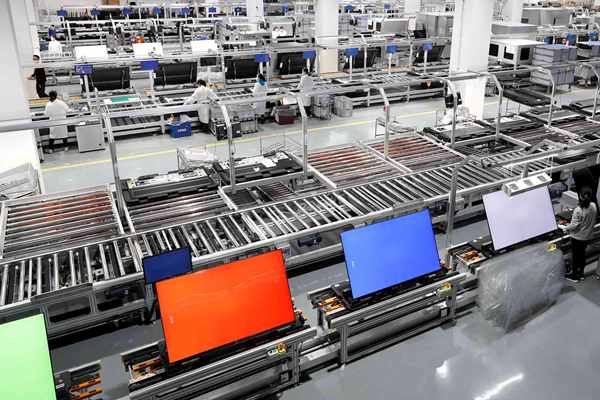
The image shows a sophisticated roller conveyor-based assembly system for flat-panel television production. This system uses a modular cell layout with multi-tier conveyor topology. Unlike traditional linear assembly lines, this configuration employs a matrix-style arrangement where parallel sub-lines feed into main assembly arteries. This enables concurrent processing of multiple product variants. The visible conveyor network consists of powered roller sections, gravity-fed buffer zones, and pneumatic lift-transfer mechanisms that orchestrate the flow of display panels, chassis assemblies, and finished units across the factory floor.
The line architecture reflects lean manufacturing principles with deliberate decoupling points. These are visible as lateral buffer accumulations between process stages, allowing individual stations to operate at slightly varying paces without constraining overall throughput. This design accommodates the inherent variability in TV assembly, where different screen sizes ranging from 32-inch to 85-inch units impose dramatically different handling requirements and cycle times.
Core Process Modules and Assembly Sequence
Panel Handling and Inspection Station
The most prominent elements in the foreground are LCD and OLED display panels in various test states, exhibiting solid red, blue, and white screen patterns. This represents the aging and electrical testing phase where panels undergo burn-in testing to identify pixel defects, backlight uniformity issues, and color calibration deviations. The roller conveyor system at this stage must accommodate extreme fragility. Display panels are transported on customized pallet fixtures with vacuum-suction or foam-cushioned interfaces, preventing contact pressure on the glass substrate. The conveyor speed is precisely regulated to ensure test duration compliance while maintaining line balance.
Chassis and Backlight Unit Assembly
Upstream of the panel testing zone, the line integrates metal chassis mounting and LED backlight bar installation. This station requires careful sequencing. The plastic or metal rear cabinet is positioned on the conveyor pallet, followed by the placement of the reflector sheet, light-guide plate, and diffuser films. The roller conveyor at this stage features accumulation capability, meaning individual pallet zones can independently stop while the main drive continues, allowing operators to complete delicate film-layering operations without time pressure. The visible lateral transfer mechanisms enable chassis units to move from sub-assembly lines into the main panel mating line.
Main Board and Power Supply Integration
The image reveals multiple electronic component boxes positioned alongside the conveyor, containing mainboards, power supply units, and interface modules. This station executes the critical marriage of electronic systems to the display assembly. The conveyor design incorporates height-adjustable work surfaces and tilt-capable pallet fixtures, enabling ergonomic access to the rear panel where HDMI ports, USB interfaces, and power inlets are located. Automated screw-driving systems, mounted on overhead gantries or integrated into station fixtures, apply controlled torque to secure heat-sinked components without damaging the printed circuit board.
Final Assembly and Packaging Preparation
The background shows packaging material staging areas and finished goods accumulation zones. At this terminal stage, the completed TV unit receives front bezel attachment, stand or wall-mount bracket installation, and protective film application. The roller conveyor transitions to chain-driven pallet conveyors with precise stopping accuracy for automated packaging machinery integration. The visible lateral buffer lanes serve as sequencing areas where products are organized by customer order or shipping destination before entering the final cartoning and palletizing operations.
Conveyor Technology and Material Handling Systems
The roller conveyor system visible throughout the image represents a gravity-assisted powered roller hybrid design. Several key technical specifications define this system. Roller pitch is calculated based on minimum product footprint to prevent pallet tipping, typically using 75mm to 100mm spacing for television applications. The drive mechanism uses 24-volt DC motorized rollers with zone-control logic, enabling individual conveyor segments to start or stop based on downstream availability. Load capacity is engineered for 150 to 300 kilograms per pallet position, accommodating the substantial weight of large-format displays with protective fixtures. Accumulation pressure is minimized to less than 5 Newtons per roller to prevent screen damage during line stoppages.
The overhead cable management and utility distribution visible in the image supports the conveyor controls, station lighting, and test equipment power requirements. This infrastructure eliminates floor-level cable runs, maintaining clean aisles for material replenishment and maintenance access.
Quality Integration and Process Control
The colored test screens visible on the line demonstrate in-line electrical verification rather than offline batch testing. Each panel undergoes several critical inspections. Uniformity analysis uses camera-based systems to capture screen luminance across multiple color channels, detecting mura clouding defects invisible to human operators. Pixel defect mapping enables automated identification of dead pixels, stuck sub-pixels, and color deviation clusters. Interface functionality verification uses signal generators to test HDMI, USB, and network port integrity at production speeds.
The conveyor system integrates RFID or barcode tracking at each pallet position, maintaining genealogical records linking panel serial numbers to backlight batch codes, mainboard firmware versions, and operator identification. This traceability is essential for warranty management and field failure analysis.
Ergonomics and Labor Organization
The image shows operators positioned at standing-height workstations with lateral access to the conveyor. The line design incorporates 180-degree rotation capability at certain stations, allowing dual-sided assembly for large-format units that exceed comfortable single-operator reach. The visible blue component bins and kitting containers represent point-of-use material delivery, minimizing operator walking distance and maintaining visual inventory control.
The multi-tier conveyor structure, visible in the background with elevated return lanes, creates a closed-loop pallet circulation system. Empty pallets return to the line start via overhead or lateral gravity conveyors, eliminating manual pallet transport and reducing forklift traffic in the assembly area.
Conclusion
This flat-panel television assembly line exemplifies the evolution from rigid mass-production systems to flexible, variant-capable manufacturing platforms. The roller conveyor infrastructure serves not merely as a transport mechanism but as the spatial framework within which testing, assembly, and quality verification converge. For conveyor system suppliers, the critical design parameters extend beyond speed and load capacity to encompass electrostatic discharge protection, cleanroom-compatible materials, and modular reconfigurability that accommodates rapid product lifecycle transitions. The visible integration of test screens directly on the moving line, the matrix-style buffer architecture, and the ergonomic material flow design collectively represent the contemporary standard for consumer electronics assembly, where conveyor technology and process engineering are indistinguishable from the manufacturing system itself.
Email:[email protected]