
Air Conditioning Outdoor Unit Assembly Line
1. Line Architecture and Layout Design
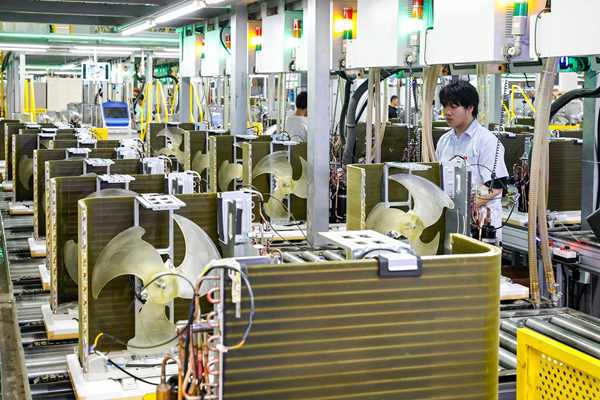
The image shows a typical linear rigid-type assembly line for air conditioning outdoor units. The production system uses standardized pallets as workpiece carriers, transported via a chain conveyor system to ensure precise movement between stations. The entire line divides into multiple functional zones. The front section serves as the condenser component pre-assembly area. The middle section handles the fan system and piping installation. The rear section manages electrical control system integration and final testing. Station spacing is calculated through time-and-motion balancing studies, with takt time typically controlled between 45 and 60 seconds to optimize both throughput and labor allocation.
2. Core Process Module Analysis
2.1 Condenser Fin Coil Assembly
The most prominent elements in the image are the neatly arranged copper-tube aluminum-fin condenser coils, which form the heart of the air conditioning heat exchange system. This station uses dedicated fixture positioning to mechanically secure the serpentine heat exchanger to the side panel frame. Fin spacing accuracy is maintained within ±0.05mm to ensure proper airflow volume and heat transfer efficiency. Modern lines integrate machine vision inspection systems to detect fin collapse, tube deformation, and other defects in real time.
2.2 Axial Fan System Installation
The image shows multiple large-diameter axial fan blades in both pre-installation and mounted states. Fan assembly represents a critical operation in outdoor unit production, encompassing sub-steps such as motor stator-to-impeller dynamic balancing, shroud alignment, and protective grille fastening. Advanced stations use servo-controlled tightening equipment with dual-parameter monitoring of torque and angle. This prevents housing deformation from over-tightening and eliminates vibration or noise issues from insufficient fastening.
2.3 Refrigeration Piping Connection Process
The piping system includes high-pressure lines, low-pressure lines, and valve connections. This station performs the critical connections preceding vacuum evacuation and refrigerant charging. Automated flaring equipment and CNC tube benders ensure copper joint integrity. Welding stations that employ flame brazing are equipped with fume extraction and purification systems. Alternatively, flameless connection technologies using hydraulic crimping equipment significantly enhance both safety and consistency.
2.4 Electrical Control Box and Sensor Integration
The electrical control modules visible above the line contain inverter drive boards, power modules, and communication interfaces. This station is responsible for wiring the control box to the compressor, fan motor, and temperature sensors. Poka-Yoke error-proofing designs and wire color coding minimize connection errors. High-end lines introduce collaborative robots at this station to perform precision insertion and screw fastening operations.
3. Conveyor System and Tooling Technology
The line uses accumulating conveyor chain or double-speed chain technology, allowing individual pallets to stop at stations without disrupting the main line flow. This achieves flexible takt control. Each fixture pallet is equipped with an RFID chip or barcode carrier to record product model, process parameters, and quality data, enabling full traceability. The stack lights visible above each station, colored red, yellow, and green, provide real-time feedback on equipment status and quality alarms.
4. Quality Control and Information Integration
Modern air conditioning assembly lines are deeply integrated with Manufacturing Execution Systems. This enables several critical capabilities. Process error-proofing uses barcode verification to prevent wrong-part installation and omission. Torque data management ensures 100 percent data collection and upload for all critical fastening points. Leak detection systems perform online helium or halogen testing with sensitivity reaching 1×10⁻⁷ Pa·m³/s. Operational testing stations at the end of the line perform powered running tests to verify fan speed, current waveform, and noise decibel levels.
5. Human-Machine Collaboration and Lean Design
The image demonstrates that the line retains necessary manual stations, embodying the human-machine collaboration philosophy. Operators execute flexible assembly operations that machines cannot replicate, following standardized work instructions. Station heights conform to ergonomic standards, and materials are supplied in kitting format to eliminate wasted motion from turning and reaching. Quality confirmation stations and rework buffer zones are positioned along both sides of the line, practicing the lean principle of Jidoka, or autonomation, which stops the line immediately upon abnormality detection to prevent defect propagation.
6. Conclusion
The air conditioning assembly line represents a benchmark application in refrigeration equipment manufacturing. Its technological evolution is clearly directed toward several goals. Modular design reduces changeover time. Digital twin technology enables virtual commissioning. AI vision replaces manual inspection. 5G and edge computing support real-time control. For conveyor equipment suppliers, understanding the OEM’s core requirements for high takt time, zero defects, and rapid changeover is fundamental to delivering competitive solutions. What this line demonstrates is not merely the precise combination of mechanical structures, but rather the modern manufacturing paradigm where process engineering, informatization, and lean management converge.
Email:[email protected]