
Manufacturing System Overview
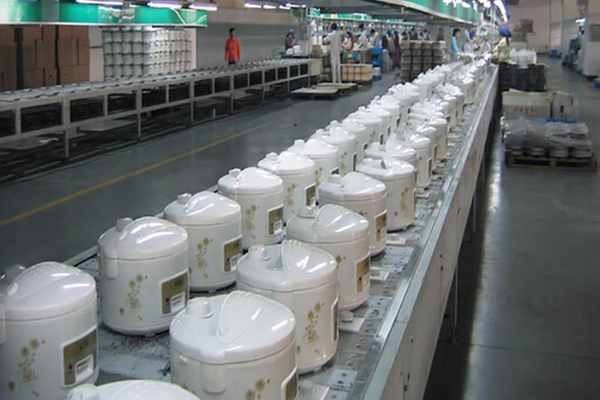
At our manufacturing facility, we design and build conveyor-based assembly systems purpose-built for the high-volume production of small kitchen appliances. The image captured on our production floor illustrates a fully operational rice cooker final assembly line. This continuous-flow system combines precision conveyor engineering with systematic component integration to transform sub-assemblies into finished, market-ready products.
Conveyor System Architecture
Our rice cooker assembly line employs a chain-plate conveyor backbone, a configuration specifically selected for small appliance manufacturing. This design provides stable, continuous transport across multiple assembly stations without the vibration or slippage inherent to belt-based systems. The chain-plate design ensures positive drive engagement, maintaining exact positional accuracy for each rice cooker unit as it progresses through the line, regardless of line speed or accumulated load.
The conveyor operates on a palletized carrier system where each rice cooker rests on an individual tooling pallet designed to match the appliance’s base geometry. These pallets are precision-machined to secure the unit during assembly operations while allowing 360-degree access for operators at both sides of the line. Pallet spacing is calculated to match the takt time, ensuring that completed units exit the line at a predictable, synchronized rate aligned with downstream packaging and logistics operations.
The line architecture follows a linear, single-direction flow with integrated buffer zones at critical handoff points. This layout minimizes cross-traffic interference while allowing temporary accumulation between stations where assembly times may vary due to component complexity or operator skill requirements. The conveyor drive system uses a variable-frequency inverter-controlled motor, enabling real-time speed adjustment for production ramp-ups, model changeovers, or quality hold situations without mechanical shutdown.
Assembly Process: Station-by-Station Integration
Line Entry and Base Housing Loading
The production journey begins at the line entry station, where the rice cooker base housing, typically a formed aluminum or stainless steel inner pot assembly, is loaded onto the pallet from an upstream sub-assembly cell. The base housing arrives pre-fitted with the heating element and thermal fuse, having undergone resistance welding and electrical continuity testing in a dedicated pre-assembly line that feeds this main conveyor.
Outer Shell Assembly and Insulation
At the first main-line station, the outer shell is positioned and aligned with the base housing. Operators use pneumatic clamping fixtures mounted at the station to hold the shell in position while thermal insulation material is inserted between the inner pot and outer casing. This insulation layer, critical for energy efficiency and exterior temperature safety, is cut to specification from roll stock and placed using template-guided fixtures that ensure consistent coverage without gaps or compression inconsistencies.
Control Panel Integration
The assembly then advances to the control panel integration station. The printed circuit board assembly, previously populated with surface-mount components via automated pick-and-place and reflow soldering in a separate SMT line, is mounted to the outer shell. The PCB incorporates the microcontroller, temperature sensor interface, and safety cut-off circuitry. Operators connect the heating element leads, thermal fuse wiring, and power cord through a harness routing system that prevents wire chafing and maintains electrical clearance standards. Each connection is verified using a station-integrated continuity tester that flags open circuits or incorrect pin assignments before the unit proceeds.
Lid Assembly
At the lid assembly station, the hinged lid sub-assembly, comprising the outer lid, inner steam shield, and pressure relief valve, is attached to the main body via a spring-loaded hinge mechanism. The hinge torque is calibrated using a digital torque wrench with automatic data logging, ensuring that the lid opens smoothly under user operation while maintaining sufficient closing force to seal steam during the cooking cycle. The steam vent assembly is then inserted and function-tested for proper airflow resistance.
Cosmetic Finishing and Branding
The subsequent station handles cosmetic finishing and branding integration. Decorative labels or silk-screened panels are applied using alignment jigs, followed by a visual inspection for adhesive voids, wrinkles, or registration errors. The control panel overlay, typically a membrane switch with LED indicators, is adhered to the front interface, completing the user-facing aesthetic assembly.
Final Integration and Quality Verification
Power Cord and Bottom Cover
The last assembly station focuses on power cord attachment and bottom cover installation. The three-prong power cord is routed through a strain-relief grommet and terminated to the internal terminal block, with a pull-test verification ensuring that the cord withstands the specified mechanical load without displacement. The bottom cover, often a stamped steel or molded plastic panel, is then secured with self-tapping screws using an automated screw-driving system that maintains consistent torque and depth to prevent cover deformation or thread stripping.
Inline Testing Zone
Upon completion of mechanical assembly, the rice cooker enters the inline testing zone, a dedicated section of the conveyor where line speed is reduced to allow comprehensive functional verification. Each unit undergoes a dry-run heating test: the control system is powered, the heating element is energized for a calibrated duration, and the temperature sensor response is recorded against a reference curve. Units exhibiting out-of-tolerance heating profiles or sensor drift are automatically diverted to a rework lane via a pneumatic pusher mechanism, while compliant units continue to the packaging station.
Production Flexibility and Throughput
Our assembly line is engineered for model flexibility, accommodating multiple rice cooker variants ranging from basic mechanical-switch models to microprocessor-controlled multi-function units through quick-change tooling pallets and adjustable station fixtures. Changeover between models is achieved in under 30 minutes, involving pallet exchange, fixture repositioning, and control parameter updates via the station PLCs.
The line operates at a nominal throughput of 400 units per hour for standard-capacity models, with the conveyor system and station spacing designed to support this cadence without operator overload or quality degradation. The dual-sided operator configuration maximizes labor efficiency while maintaining ergonomic work heights and reach envelopes, reducing fatigue-related defects over extended production shifts.
| Specification | Detail |
|---|---|
| Nominal throughput | 400 units per hour |
| Changeover time | Under 30 minutes |
| Conveyor type | Chain-plate with palletized carriers |
| Drive system | Variable-frequency inverter-controlled motor |
| Product variants | Mechanical-switch to microprocessor-controlled |
Why This Line Defines Our Capability
This rice cooker assembly line exemplifies our approach to small appliance manufacturing systems. It combines a conveyor infrastructure engineered for stability and precision with workstations that balance manual assembly expertise and automated verification, all synchronized to a takt-driven production rhythm. From the first pallet load to the final functional test, every element of this line is designed to deliver consistent, repeatable assembly quality at the volumes required by global appliance markets.