
What is the difference between a washing‑machine assembly line and a washing‑machine production line? A full analysis from the equipment manufacturer’s perspective.
When planning washing‑machine manufacturing plants for clients, we frequently encounter the same issue: the two terms “washing‑machine assembly line” and “washing‑machine production line” are used interchangeably in requirement documents. Some clients intend to purchase a “washing‑machine production line”, while what they actually require is only the final‑assembly section. Others prepare budgets based on a “washing‑machine assembly line”, yet further communication reveals that upstream processes such as inner‑drum manufacturing and injection moulding are also included within their scope of requirements.
The distinction between these two terms is not merely a wording issue. They correspond to two different equipment systems with investment scales of different magnitudes. This article gives clear definitions from an equipment perspective and breaks down the components of a complete washing‑machine production line.
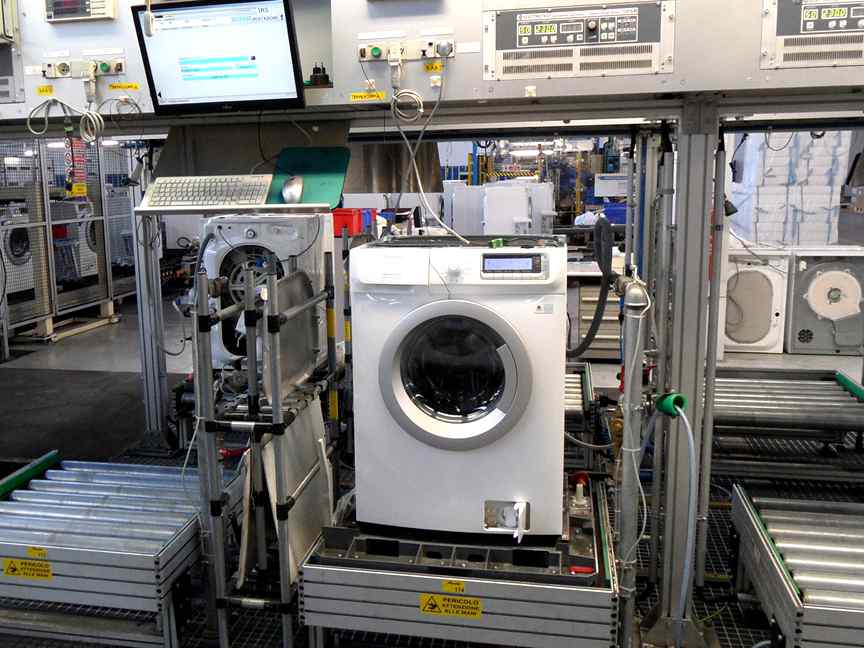
Term Definitions
Washing‑machine Production Line: A complete manufacturing system from raw materials (steel coils, stainless‑steel sheets, plastic pellets) to finished units coming off the line. It includes workshops for upstream processes, the final‑assembly conveyor line, as well as inspection and packaging sections.
Washing‑machine Assembly Line: In industry context, this generally refers specifically to the final‑assembly section — a continuous conveyor system where pre‑formed cabinets, inner and outer drums, motors and electronic control components are assembled into finished units at a set cycle time.
In short: an assembly line is a subset of a production line. “Production line” is discussed for full‑plant planning, while “assembly line” refers to final‑assembly retrofits. Their quoted prices can differ by an order of magnitude.
Upstream Processes: The Highest‑investment Segment of a Washing‑machine Production Line
Many people imagine a washing‑machine factory as nothing more than a long conveyor belt. In reality, final assembly accounts for only a small share of total investment in a full washing‑machine production line. Major capital expenditure lies in upstream processes:
- Sheet‑metal Section: Process flow: steel coil uncoiling → levelling → blanking → bending forming, producing cabinets and bases. Bending precision of cabinets determines the uniformity of assembly gaps for complete units.
- Inner‑drum Manufacturing Section: A unique core upstream process for washing machines. Stainless‑steel sheets go through rolling, longitudinal seam welding (TIG or laser welding), stretching & shaping, dewatering hole punching and flanging to form washing inner drums. The roundness and welding quality of inner drums directly affect vibration levels during high‑speed spin‑drying.
- Injection‑moulding Section: Plastic parts including outer tubs, control panel bases, face panels and detergent boxes are manufactured by injection‑moulding machines. As large deep‑cavity components, outer tubs demand high clamping force and precise mould temperature control for injection‑moulding equipment.
Balancing System: The Technical Core of Washing‑machine Production Lines
Compared with other home appliances, washing machines feature high‑speed rotation under eccentric load conditions. Spin‑drying speed can reach thousands of revolutions per minute. Poor balancing systems will inevitably lead to excessive vibration and noise. This procedure is completed in upstream workshops and is invisible on the final‑assembly line.
It should be noted that top‑loader and front‑loader washing machines adopt completely different balancing solutions with differentiated equipment configurations:
- Top‑loading Washing Machine: Balance Ring Filling. An annular cavity is fitted at the top of the inner drum, filled with salt water or embedded steel balls. Liquid or steel balls automatically shift to counteract eccentricity. The core device is the balance‑ring filling machine; metering accuracy directly determines balancing performance.
- Front‑loading Washing Machine: Counterweight Press‑fitting. Front‑loading washing machines rely on concrete or cast‑iron counterweights to lower the centre of gravity and suppress vibration, working together with shock absorbers and suspension springs. Core equipment includes counterweight press‑fitting and fastening stations, with strict process windows for pressing force and tightening torque.
Whichever solution is applied, production lines must be equipped with dynamic‑balance testing. Each inner‑drum assembly undergoes rotation testing; units with excessive vibration values will be reworked or scrapped. This is a special inspection procedure exclusive to washing‑machine lines, which cannot be found on refrigerator or air‑conditioner production lines.
Washing‑machine Assembly Line (Final‑assembly Section): Cycle Time and Line Balancing
Components finished by upstream processes enter what is commonly known as the “washing‑machine assembly line”. Typical process flow for washing‑machine final assembly:
Outer‑tub assembly infeed → motor & clutch (or direct‑drive motor) installation → inner‑drum fitting → shock absorber and suspension rod mounting → cabinet assembly → water inlet & drainage system installation → control panel fitting → final inspection → packaging and palletising.
The core indicator for final‑assembly lines is cycle time: one finished machine rolls off the line every several tens of seconds, and all workstations are arranged for balanced cycle‑time performance. Given the heavy weight of washing‑machine units, heavy‑duty slat chains or speed‑multiplying chains are generally adopted for conveying systems, with turnover machines configured for bottom‑side operations.
The final checkpoint is full‑unit final inspection. Each machine runs with water filled to test washing & spin‑drying performance, noise level, water tightness and electrical safety. Spin‑drying noise performance essentially serves as the final acceptance of upstream dynamic‑balance quality.
Practical Value of Distinguishing the Two Terms
Clarifying the difference between “washing‑machine assembly line” and “washing‑machine production line” delivers tangible benefits in at least three scenarios:
- Budget Preparation: A final‑assembly assembly line is only part of a complete production line. If a production‑line‑level budget is submitted merely based on assembly‑line scope, additional funding will inevitably be required mid‑project.
- Supplier Selection: Suppliers for standalone final‑assembly lines differ greatly in capability from turnkey full‑line suppliers. Misused terminology in requirement documents will attract mismatched vendors.
- Defining Technical‑retrofit Priorities: Frequent complaints about spin‑drying vibration and noise mostly stem from dynamic‑balance processes rather than final‑assembly lines. Insufficient production capacity calls for troubleshooting cycle‑time balance on the final‑assembly line.
Conclusion
A washing‑machine assembly line determines assembly speed; upstream processes within a washing‑machine production line determine product quality. Identify bottleneck processes before production‑line planning.
We specialize in the planning and manufacturing of washing‑machine assembly equipment and complete production lines. Our business covers inner‑drum manufacturing, balancing systems, final‑assembly conveyance and in‑line inspection. Should you have requirements for new‑line construction or production‑line retrofitting, please feel free to contact us for discussion. SKD & CKD services are available.