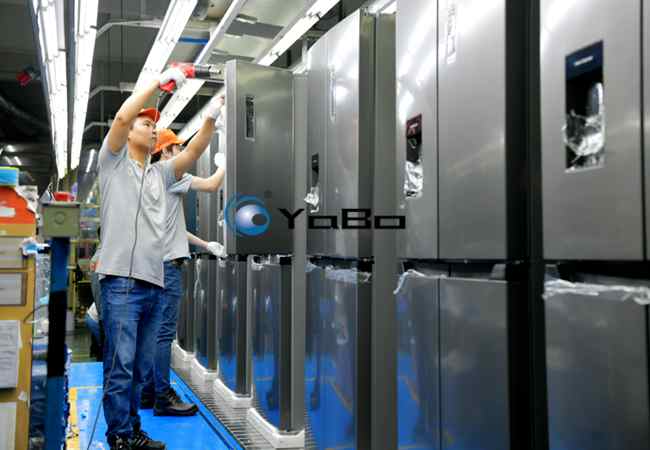
The design of the door affects the volume, space utilization and usage scenarios of the refrigerator, and is an important symbol to distinguish the appearance and structure in the production of the refrigerator assembly line. For example, single-door refrigerators, double-door refrigerators, multi-door refrigerators, etc.
Product Details
Refrigerators are core residential cooling appliances whose structural complexity varies widely across door configurations. Single-door, double-door, multi-door and side-by-side models differ significantly in inner tank structure, refrigerant pipeline layout and assembly process requirements. Large-scale, standardized production of qualified refrigerator products depends on a complete and reliable refrigerator production line, and the refrigerator assembly line is the core section that determines final product quality, production beat and overall output capacity.
For refrigerator manufacturing plants, the conveying system is the backbone of the entire refrigerator pipeline. It runs through all process stations from component pre-assembly to finished product packaging, ensures workpieces are transported at a stable and controllable speed, and directly impacts the line’s production efficiency, product pass rate and long-term operating cost.
Basic knowledge of assembly conveying systems
In industrial assembly engineering, conveying equipment is usually classified into heavy-load and light-load categories based on bearing capacity and process positioning:
Heavy-load conveying lines serve core process sections with heavy workpieces and high positioning accuracy requirements, such as cabinet foaming, evaporator fixing and door body installation. They require high structural rigidity, stable operation under continuous heavy load, and long service life.
Light-load conveying lines are used for auxiliary material transfer, component feeding, post-assembly inspection and packaging sections. They focus on layout flexibility, low operating noise and surface protection for finished workpieces.
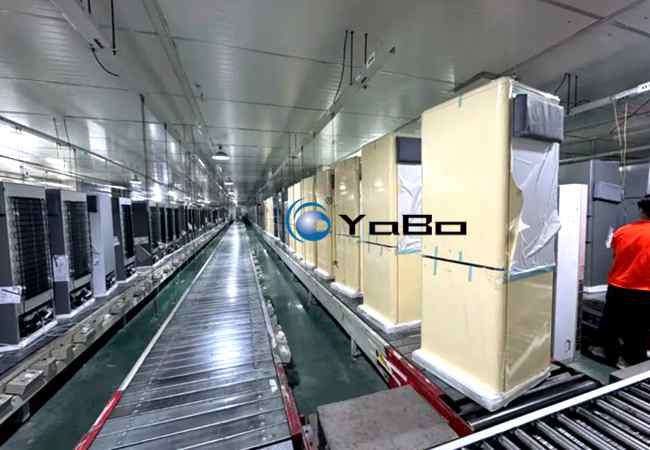
Refrigerator production features a wide weight span of workpieces — from light empty inner tanks of several kilograms to foamed complete cabinets of 80-150kg. For this reason, the “heavy-load plate chain line + light-load roller line” combination has become the global mainstream configuration for refrigerator assembly lines. This scheme can accurately match the process requirements of each section, and realize efficient, low-cost and stable mass production.
I. The refrigerator production line is the core facility to realize large-scale and standardized production of refrigerators.
As two key conveying equipment, the plate chain line and the roller line are responsible for material transportation and process connection tasks in different links in the assembly line.
II. The plate chain line is the core equipment in the refrigerator assembly line that undertakes heavy load and high-precision conveying tasks.
It consists of high-strength metal chain plates and achieves continuous operation through chain drive. Its distinctive feature is its strong load-bearing capacity. A single chain plate can carry a weight of more than 200kg. It can stably transport various heavy-loaded workpieces from empty boxes to foamed heavy boxes (80-150kg), and the conveying surface is flat and matched with positioning tooling to ensure that the workpiece does not shake during the assembly process, accurately meeting the accuracy requirements of key processes such as evaporator fixing, pipeline laying, and door body installation. At the same time, it is resistant to wear and has a long life. It can achieve speed-adjustable transportation of 0.5-3m/min through speed reducers and motors. It is widely used in pre-assembly sections, foaming sections and core parts of final assembly. It is the key to ensuring the orderly advancement of heavy-load processes. The chain plate adopts a standardized modular design, which is easy to disassemble and maintain. Spare parts are highly universal, and can adapt to the power supply and production environment of overseas factories.
III. The roller line has flexible transportation as its core advantage.
The conveying surface is composed of powered or non-powered rollers, and the workpiece is driven to move through the rotation of the rollers. Its structure is flexible and can be designed into turning, lifting, etc., saving workshop space, low noise and good protection to the appearance of workpieces. The polyurethane roller can effectively avoid scratching the exterior parts of the refrigerator. According to different needs, the power roller is suitable for long-distance automated transportation, and the unpowered roller is suitable for short-distance manual auxiliary operation. The transportation speed can be adjusted to 3-10m/min through the frequency converter, which is perfectly suitable for the pre-assembly auxiliary transportation of parts and components, and the light operation process after final assembly, the connection between the inspection and packaging section, and the diversion and temporary storage of finished products cooperate with the plate chain line to form an efficient production process of “plate chains for heavy loads and rollers for light loads”. Polyurethane coated rollers have good wear resistance and temperature adaptability, and can maintain stable performance in tropical and subtropical workshop environments, which is very suitable for overseas factory configuration.
IV. Turnkey EPC Delivery Process for Refrigerator Assembly Line
Beyond core conveying equipment, we provide full turnkey EPC solutions for complete refrigerator production lines, covering the entire project lifecycle from initial design to staff training. This end-to-end delivery model eliminates multi-vendor coordination risks for clients, especially for overseas refrigerator manufacturing projects, and ensures the refrigerator assembly line can be put into production on schedule with stable, long-term performance.
We follow a standardized 5-stage engineering delivery workflow, tailored to the actual conditions of overseas industrial environments:
1. Engineering & Customized Design
Based on the client’s target annual output (100,000 to 500,000 units), workshop dimensions, refrigerator product portfolio (single-door, double-door, multi-door models) and local power grid conditions, our engineering team develops a full set of refrigerator production line layout schemes. The design scope includes process flow planning, 2D/3D workshop general layout, civil engineering interface parameters, and power & refrigerant pipeline configuration. For projects in tropical and subtropical regions, we specially optimize equipment ventilation and heat dissipation structures to adapt to high-temperature workshop environments. All designs strictly follow international industrial standards and reserve upgrade margins for future capacity expansion and product iteration.
2. Factory Manufacturing & Pre-delivery Inspection
All core equipment of the refrigerator assembly line — including plate chain lines, roller lines and matched positioning tooling — are manufactured in our factory under a standardized modular production system. Each device undergoes strict quality inspection before delivery: 24-hour continuous load testing, running accuracy calibration, and anti-corrosion coating inspection. The modular design ensures high interchangeability of all components, which greatly reduces on-site installation duration and later maintenance costs for overseas clients.
3. On-site Installation Guidance
We dispatch senior field engineers to direct on-site installation, working in coordination with the client’s local construction team. The installation follows a strict technical sequence: foundation marking → main frame assembly → conveying unit splicing → electrical wiring → safety device installation. Our engineers control construction quality on site and verify that the installation accuracy of each section of the refrigerator pipeline meets design tolerances, avoiding rework and schedule delays.
4. Commissioning & Trial Production
After mechanical and electrical installation, we carry out step-by-step full-process commissioning: no-load running test, load test with simulated workpieces, and joint commissioning with the client’s existing process equipment (such as foaming machines, helium leak detectors and packaging equipment). We then run trial production with actual refrigerator products to verify line cycle time, positioning accuracy and product pass rate, and adjust process parameters on site until the refrigerator production line reaches its designed capacity and quality standards.
5. Technical Training & After-sales Support
We provide systematic practical training for the client’s on-site operators and maintenance personnel, covering daily equipment operation, routine maintenance, common fault troubleshooting and wearing parts replacement. A complete set of operation manuals, spare parts catalogs and electrical schematic drawings is delivered along with the project. For overseas clients, we offer long-term remote technical guidance and fast spare parts supply services to ensure stable long-term operation of the refrigerator assembly line.